Why a Handle Changes How an Object Is Used
Why a handle changes how an object is used comes down to grip, reach, and movement. Learn what shapes and materials suit familiar household tasks.
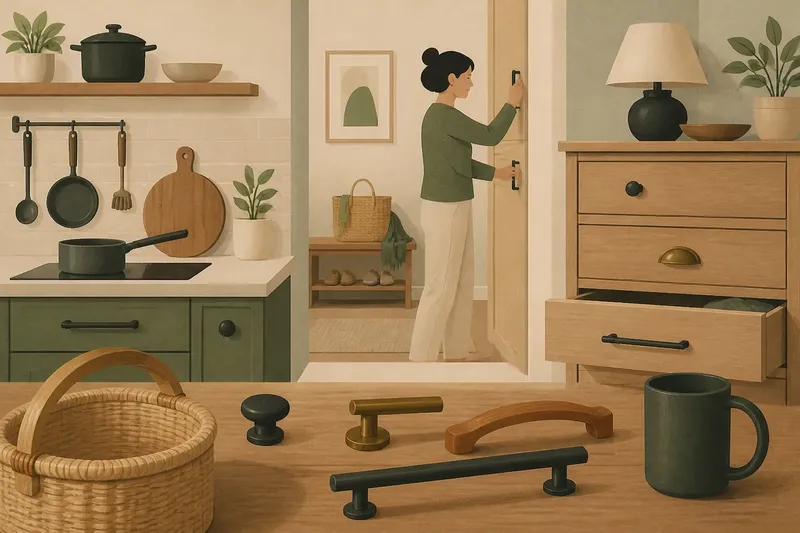
A mug handle changes how a hot drink travels from counter to chair; a drawer pull changes where your hand goes before the drawer moves. Why a handle changes how an object is used becomes clear in these small actions: its shape, position, and material invite a particular grip and guide the force of a task. The useful choice depends on what you need your hand to do.
What does the task ask your hand to do?
Start with the movement, not the look. A handle may need to support a lifted load, give a quick point of contact, or let you pull along a straight path. Those jobs call for different forms.
- For lifting and carrying: Look for space for the fingers to curl and a grip that feels secure without pinching. A basket needs a handle that stays comfortable as its contents shift; a shallow tab may be enough for a light lid.
- For turning: A knob or short lever can make a small rotation easy to understand. A round door knob suits a turning motion, while a lever lets the hand press down or move sideways.
- For pulling: A drawer pull or cabinet handle should offer a place for the fingers to hook or wrap, aligned with the direction the object moves. A small decorative stud can be awkward if the drawer is stiff or the user has limited grip.
- For steadying: A handle may provide a second point of control rather than carry the full weight. A saucepan handle, for instance, helps guide a pan as it is lifted, while the other hand may support the opposite side.
These are not rigid categories. The same handle can lift, pull, and steady. But naming the main movement helps explain why a shape that looks right can feel wrong in use.
Where should the handle sit?
Position determines where the hand meets an object and how the force travels through it. A handle near the center of a box can help balance a lift. A pull set toward the edge of a drawer gives leverage for opening it, but it also needs to be reachable without an awkward wrist angle.
Consider the approach as well as the motion. A loop on a kettle needs clearance for fingers and should not force the wrist against a hot surface. A handle on a low cabinet may be easier to reach from above, while a tall cupboard can call for a grip that remains accessible from the floor. For shared household objects, think about different hand sizes and the direction people naturally approach from.
Imagine replacing a small, smooth knob on a frequently used kitchen drawer with a wider bar pull. The drawer’s position stays the same, but a hand can wrap around the bar instead of pinching the knob. The expected observable change is a more direct pull, especially when the drawer is full. If the bar projects too far into a walkway, though, its added grip may create a snagging point; placement has to suit the room as well as the hand.
Which material suits the contact?
Material affects temperature, texture, and the way a handle meets the skin. Wood often feels less cold than metal and can offer a dry, familiar grip. Metal can be slim and durable, but its surface may feel cold or become uncomfortable near heat. Ceramic is hard and easy to wipe, though a narrow ceramic handle can press sharply against fingers. These are qualities to weigh against the object’s task, not rankings of one material over another.
Surface finish matters too. A polished handle may be pleasant to touch but slippery with damp hands. A textured or matte surface can offer more friction, while deep grooves may collect grime and be harder to clean. On a frequently handled object, look for a finish that stays comfortable and can be maintained with ordinary care appropriate to the material.
For a heavy pot, a broad handle with a secure attachment and enough room for the intended grip matters more than a decorative surface. For a small bedside drawer, a modest wooden pull may be comfortable and visually quiet. If the object gets hot, wet, or exposed to cleaning products, check its maker’s instructions and relevant product labeling before choosing or changing a handle.
How do you choose for a particular situation?
Is a loop or a bar better for carrying?
A loop suits a hand that needs to pass through or curl around a grip, as with a bucket or basket. A bar can be easier to grasp from the side and may keep fingers clear of the object, provided there is enough space around it.
When does a knob make sense?
A knob suits a light door or drawer that opens with little resistance and where a compact grip is useful. If opening requires a strong pinch or repeated pulling, a lever or bar usually offers more contact for the hand.
Should a handle match the object’s material?
Not necessarily. A contrasting material can improve comfort or grip, such as a wooden handle on a metal object. The joint between materials still needs to feel stable and allow cleaning without trapping dirt.
What if several people use the same object?
Favor a grip that does not depend on a precise finger position and can be approached from the usual directions. A broad, open shape may serve more hands than a narrow loop, but the object’s weight and available space still matter.
What is not worth optimizing?
It is rarely useful to seek a theoretically perfect grip for an object that is used lightly and comfortably already. Nor does adding texture or extra bulk automatically improve control; either can make a handle harder to clean or less pleasant in a small hand. Focus on the moment that feels strained, slippery, or awkward, then consider whether shape, position, or material is the cause.
To decide why a handle changes how an object is used, watch the hand’s path: where it reaches, how it closes, and which way it moves the object. That simple observation can guide a choice between a loop, knob, lever, or pull—and help preserve the object’s intended use without treating appearance as the whole answer.